Final Form 1040 or Estate Form 1041: What Executors File
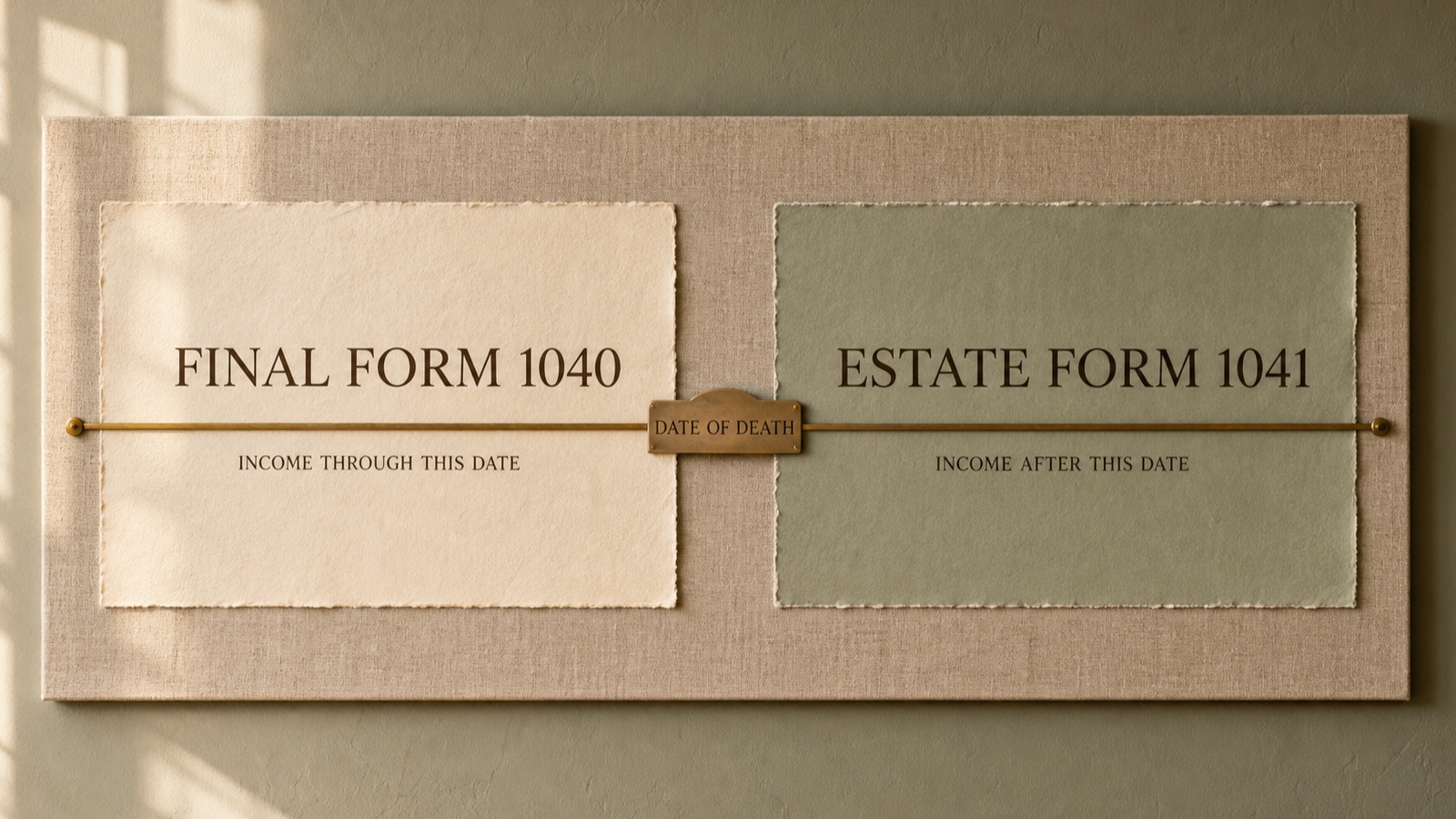
The date of death tells an executor which federal income tax return may apply. Form 1040 covers the person's income through that date. Form 1041 covers income the estate receives later.
At a glance
- The date of death splits the tax file. Income through that date goes on the final Form 1040, and later estate income may go on Form 1041.
- Under current IRS instructions, a domestic estate generally must file Form 1041 if it has $600 or more of gross income. Get the estate an EIN first.
- File Form 56 to tell the IRS you're handling tax matters. If you act for both the person and the estate, file a separate one for each.
Tax filing after a death starts with one date: the date of death. Income received through that date usually belongs on the person's final Form 1040. Income the estate receives afterward may belong on Form 1041.
Keeping those two tax files separate helps your preparer classify each payment and explain the returns to beneficiaries.
The two returns at a glance
The final Form 1040 closes the deceased person's last individual tax year. Form 1041 reports income earned by the estate, which the IRS treats as a separate taxpayer after death.
| Question | Final Form 1040 | Estate Form 1041 |
|---|---|---|
| Whose return is it? | The deceased person's | The estate's |
| Which tax ID is used? | The person's Social Security number | The estate's EIN |
| Which income is reported? | Income received through the date of death | Income the estate receives after death |
| When is it due? | The normal individual return deadline | April 15 for a calendar-year estate, or the 15th day of the fourth month after a fiscal year closes |
File the final Form 1040
You generally prepare the final return much as you would have prepared the person's return during life. Report income through the date of death, use the filing status that applies, and claim any available credits and deductions. For a calendar-year taxpayer, the return is usually due April 15 of the following year.
Check whether the person left any earlier returns unfiled. If records are missing, an authorized representative can request certain IRS transcripts with Form 4506-T.
A surviving spouse may be able to file a joint return for the year of death. Eligibility depends on the couple's filing status, whether the surviving spouse remarried before year-end, and whether a court-appointed personal representative is involved. Have the tax preparer settle the filing status before anyone signs.
Get the first three days checklist.
We'll email you a free 6-page guide to the first three days after a loss.
Decide whether the estate needs Form 1041
The estate becomes a separate taxpayer at death. Under the current IRS instructions, a domestic estate generally must file Form 1041 if it has $600 or more of gross income during its tax year. Other filing rules can apply, including when the estate has a nonresident alien beneficiary.
Estate income often includes bank interest, dividends, rent, or gains from selling estate property. Count gross income before subtracting expenses. An estate that receives little income may stay below the filing threshold, while a rented home or investment account can cross it quickly.
Get an employer identification number, called an EIN, before filing Form 1041. Use that EIN on the estate return and on financial accounts opened in the estate's name.
Separate income around the date of death
Banks and other payers sometimes issue one Form 1099 for income that falls on both sides of the date of death. Use account statements, payment records, and the payer's corrected tax forms to divide the amount between the person and the estate.
Some payments need closer review. Income in respect of a decedent means income the person earned, or had a right to receive, before death but had not yet received. A final paycheck, accrued interest, or a retirement distribution may fall into this category. Give the preparer the source document and payment date instead of deciding from the check date alone.
Choose the estate's tax year
An estate may use a calendar year or an allowed fiscal year. A calendar-year Form 1041 is generally due April 15 after the year ends. A fiscal-year return is generally due on the 15th day of the fourth month after that fiscal year closes.
That choice affects the filing schedule and the timing of beneficiary tax forms. Discuss it with a CPA or enrolled agent before the estate files its first return.
Tell the IRS who is handling the tax matters
Form 56 tells the IRS that you are acting as a fiduciary. A fiduciary is someone authorized to handle tax matters for another person or entity. If you are acting for both the deceased person and the estate, the June 2026 instructions call for a separate Form 56 for each tax file.
A refund on the final return may also require Form 1310. The IRS provides exceptions for a surviving spouse filing jointly and for certain court-appointed representatives who attach proof of appointment. Check the current form instructions with the preparer before claiming the refund.
Prepare for beneficiary Schedule K-1s
Form 1041 accounts for income the estate keeps and income allocated to beneficiaries. If the estate passes taxable income to a beneficiary, you may need to give that person a Schedule K-1 for use on an individual tax return.
The taxable income on a K-1 can differ from the cash the beneficiary received. Keep a record of each distribution's date, amount, and source so the preparer can connect the estate return to each beneficiary statement.
What to give the tax preparer
A well-organized file lets the preparer focus on the returns instead of rebuilding the estate's history. Bring these records to the first appointment:
- The death certificate and documents showing your authority to act.
- The deceased person's prior returns, income forms, and Social Security number.
- The estate's EIN letter, account statements, and income forms.
- A dated record of asset sales, estate expenses, and beneficiary distributions.
- Copies of any Forms 56, 1310, or 4506-T already filed.
Keep the tax file connected to the estate
Legacywyse keeps estate accounts, assets, expenses, distributions, and supporting documents in one working record. You can use that record to prepare a clear handoff, then let the tax professional decide how each item belongs on the returns.
Get the first three days checklist.
We'll email you a free 6-page guide to the first three days after a loss.
Sources
8 sources- IRS, Deceased Person
- IRS, File the Final Income Tax Returns of a Deceased Person
- IRS, Responsibilities of an Estate Administrator
- IRS, File an Estate Income Tax Return
- IRS Publication 559 (2025), Survivors, Executors, and Administrators
- IRS Instructions for Form 1041 (2025)
Published July 21, 2026. Last reviewed July 21, 2026 against the sources above. Legacywyse Journal articles provide general estate, probate, and personal finance information, not legal or tax advice.