Texas probate · Document guide
Proof of Death and Other Facts
A witness's sworn account of the death and other facts the court needs to consider the will. The witness answers from personal knowledge. This is testimony for the probate case, not a replacement for a death certificate.
Texas Estates Code, Chapter 256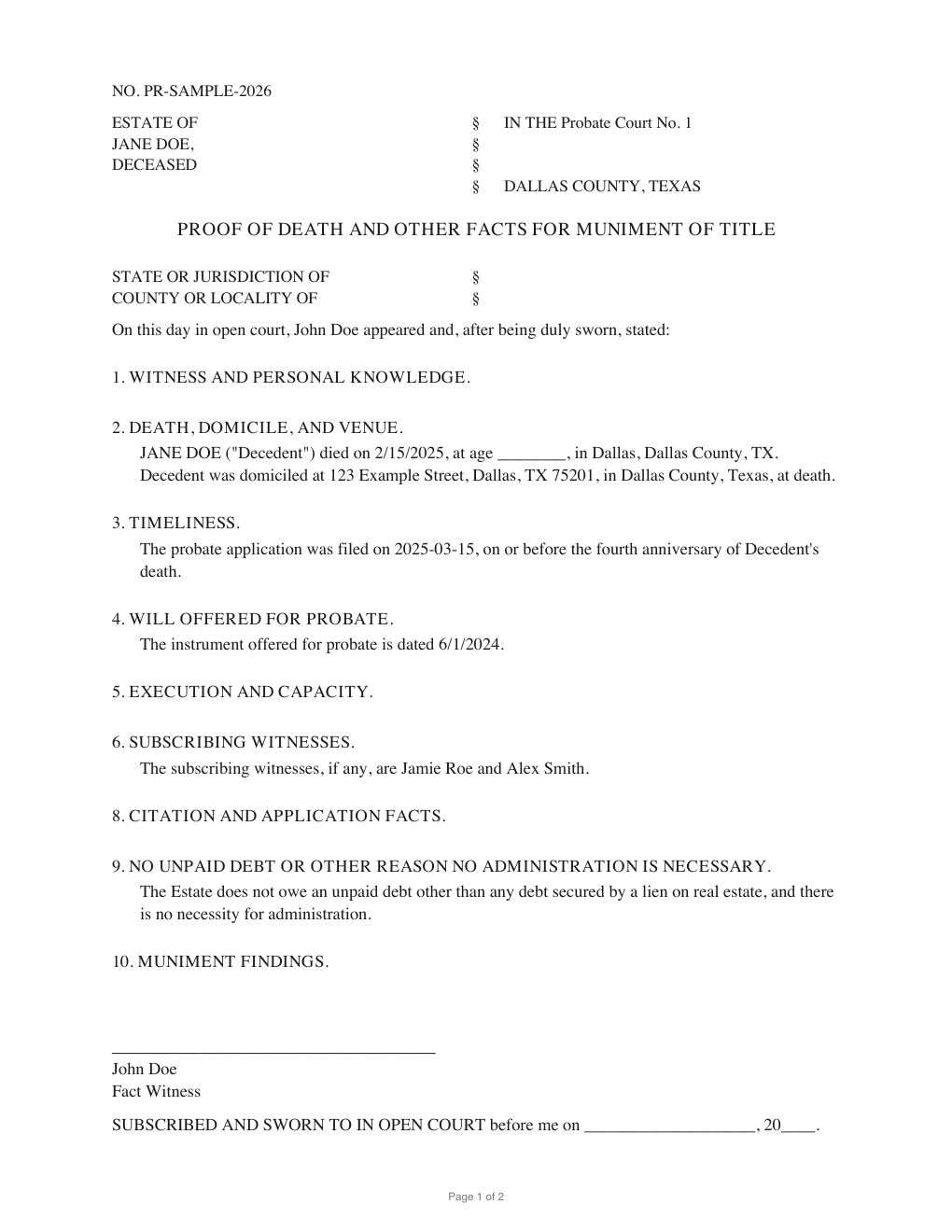
Where it goes
Filed with the probate court handling the estate, in person or through eFileTexas.gov.
Who signs
Probate Fact Witness signs.
Oath or notarization
The witness subscribes and swears to this proof in open court.
You don't have to start with a blank form.
Legacywyse uses your estate details to prepare the documents specific to your probate path.
Build my free planTell us about the estate
Answer questions about the will, family, assets, and county. Your answers help identify the likely probate path.
Save your plan and open your workspace
Create your free account to keep your checklist and supported document drafts in one place.
Review the draft, then take the next step
Add the remaining details and review your document. Follow the instructions for signatures, notarization, or court review when required. You handle filing.
What to have on hand
Death details
The person's full name, date of death, and last address. A death certificate can help confirm these.
The will
A copy of the will, including its date and the people named in it.
Witness details
Names and contact details for people who know the relevant facts, and notes about how they know them.
Get the first three days checklist.
We'll email you a free 6-page guide to the first three days after a loss.
Filing fees by county
Fees to open the probate case. Confirm with the county clerk before filing.
| County | Filing fee |
|---|---|
| Dallas County | $388 |
| Tarrant County | $380 |
| Collin County | $385 |
| Denton County | $385 |
| Harris County | $432 |
| Travis County | $378 |
| Bexar County | $391 |
Common questions
What is a proof of death and other facts affidavit in Texas?
It is a witness's sworn account of the death and of other facts the court needs before it considers a will. In Texas probate, "proof" means testimony given to the judge, and this document puts that testimony in writing. Courts use it in muniment of title, independent administration, and dependent administration cases.
Who signs the proof of death affidavit?
The witness who gives the testimony signs it. The person applying for probate usually serves as that witness. The witness answers only from personal knowledge and should say so when they do not know something, especially about the will or its signatures.
Is this the same as an affidavit of death?
No. A proof of death and other facts is testimony for a probate case, and it covers facts about the will as well as the death. It does not replace a death certificate. If a bank, title company, or county office asks for an "affidavit of death," ask which document it wants before you send this one.
Does the affidavit need to be notarized or filed?
Most courts have the witness swear to the testimony and sign it at the hearing, when the judge directs, and some ask to review a draft before the hearing. Follow your court's instructions. The signed proof is filed with the probate court handling the estate.
Let's take the next step together.
Answer a few questions about your situation, and we'll help you through what comes next.
Get started for free