How Family Review Can Reduce Inheritance Disagreements
See how Family Review in Legacywyse's estate settlement and probate app helps families score belongings, compare wishes, and divide inherited items.
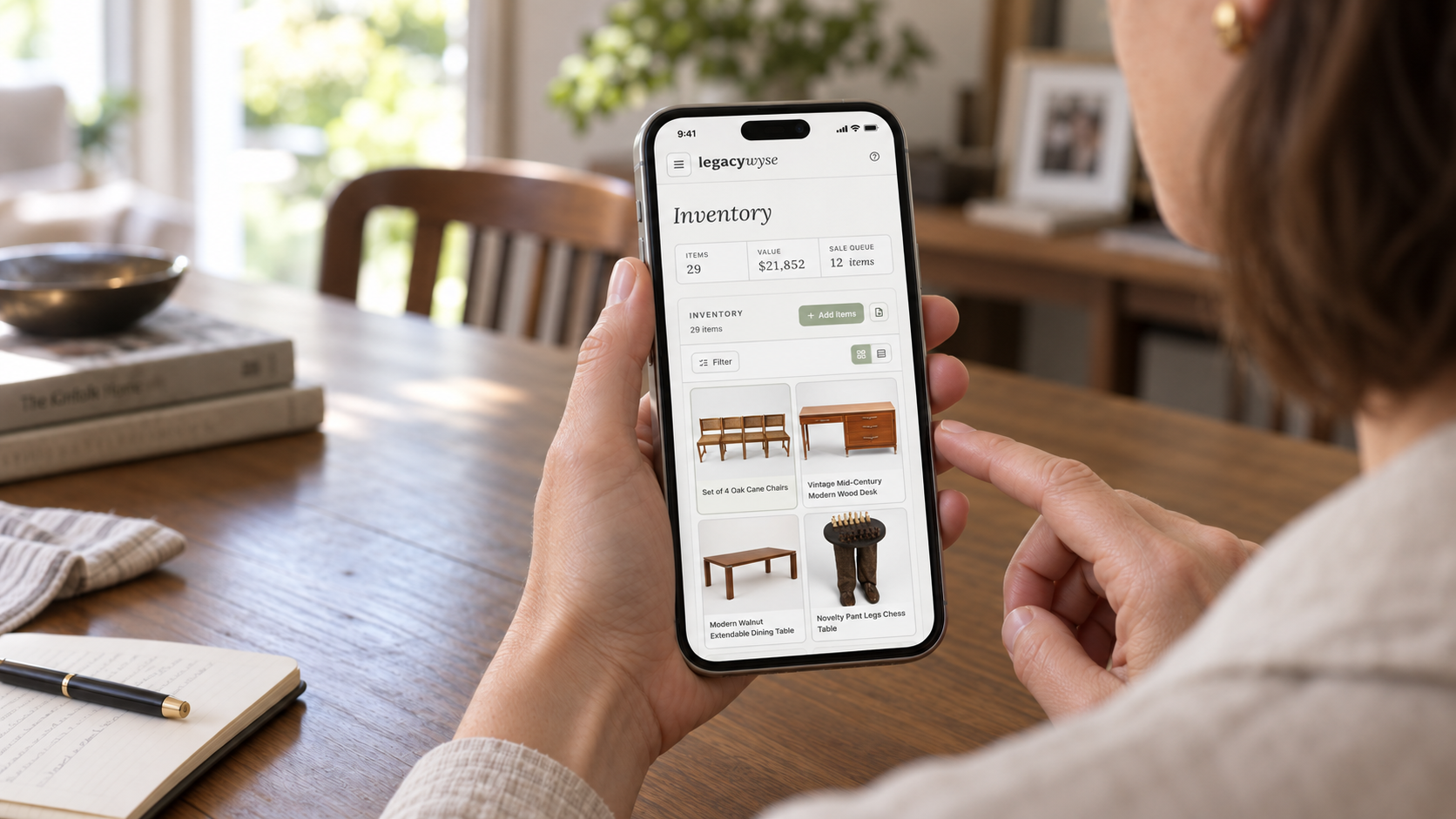
At a glance
- Choose items from your Legacywyse inventory and send them to relatives in a review round. Each person can look through the photos in their own time.
- Relatives score each item from 0 to 100 and can add notes explaining why it matters to them.
- Legacywyse turns the scores into suggested recipients, and you still decide. You can assign an item, mark it for sale or donation, or leave it undecided.
Family Review is part of Legacywyse's estate settlement and probate app. It lets you invite relatives to look through estate belongings, score the items they want, and add notes explaining why. You can see their responses alongside each item and review a proposed division before deciding who receives what.
When you're sorting a loved one's possessions, even a small object can bring up a difficult conversation. Giving everyone time to respond helps you understand what matters to them before you make those decisions.
Choose items from your estate inventory
Choose the belongings from your Legacywyse inventory that you want to include in a review round. A round is a group of items you send to selected relatives for their input. You can focus on a few keepsakes or include a larger set of belongings.
Add the recipients, name the round, and include a message about what you would like them to review. You can set a deadline or leave the round open without one. Legacywyse sends each person a link to the review.
Relatives can look through the selected items and their photos in their own time. Someone who lives far away can participate without being at the house while you're sorting.
Let relatives tell you what matters to them
Each person scores items from 0 to 100. A higher score means the item matters more to them, whether for sentimental, practical, or financial reasons. Encourage relatives to use the scores to distinguish their strongest wishes from things they would simply be happy to have.
A recipe box might be someone's first choice because they cooked with their parent. Another person might care more about a table they would use every day. An estimated resale value cannot tell you either of those things.
Get the first three days checklist.
We'll email you a free 6-page guide to the first three days after a loss.
The research behind the fair division algorithm
Legacywyse uses maximum Nash welfare, a method studied in mathematics, economics, and computer science. In their 2019 paper The Unreasonable Fairness of Maximum Nash Welfare, Ioannis Caragiannis and colleagues examined how it divides objects that cannot be split, such as jewelry or furniture.
The method adds up how much each person values the items they receive, then seeks the division with the largest product of those totals. Multiplying the totals gives weight to each person's outcome, so the method considers how the whole collection is divided.
Under the study's assumptions, including adding individual item values together, the result is "envy-free up to one good." That means that, using a person's stated values, any preference for another person's collection would disappear if one item were set aside from that collection for comparison. This is a mathematical fairness standard, not a prediction about how relatives will feel.
How Legacywyse turns scores into a proposed division
You do not need to calculate any of this yourself. Family Review takes the 0-to-100 scores submitted in the app and converts each person's positive scores into a total of 1,000 points across the round. This puts their preferences on a common scale while preserving their relative priorities as closely as the whole-point scale allows.
The software first seeks to give as many participating people as possible something they value. It then searches for the allocation that maximizes the product of their positive totals. Items without a positive score remain unassigned. Notes give you context to review; the calculation uses the scores.
Once everyone has submitted, or the round is closed, you can see the suggested recipients beside the inventory items. Review the notes alongside those recommendations. The mathematical result reflects the scores used in the calculation; it does not mean every relative agrees with the proposed division.
You stay in control of the decisions
You can change an item's decision in Legacywyse by assigning it to a recipient, marking it for sale or donation, or leaving it undecided. If a question needs more discussion, leave that item undecided while you work through it.
The round also shows who has opened the invitation and who has submitted a response. Check those statuses before closing a round so you know whose input is still missing. An opened invitation is not a completed review.
Family Review keeps the responses and item decisions together, with an activity log for the round. That gives you a place to check what has happened as you work through the belongings.
A clearer way to approach dividing inherited belongings
Family Review can reduce misunderstandings by giving relatives a way to express their wishes before belongings are divided. It also helps you see where a conversation is still needed. Scores alone cannot explain every attachment, and a proposed division will not resolve every disagreement.
Choose the items you are ready to discuss, invite the relatives taking part, and give them time to respond. Their scores and notes will give you more to work with when you review the proposed division in Legacywyse's estate settlement app.
Let's take the next step together.
Answer a few questions about your situation, and we'll help you through what comes next.
Set up a family reviewSources
1 sourcePublished September 11, 2026. Last reviewed September 11, 2026 against the sources above. Legacywyse Journal articles provide general estate, probate, and personal finance information, not legal or tax advice.