Texas probate · Document guide
Judgment Declaring Heirship
The court order naming the heirs and the share each inherits. You prepare a proposed judgment for the judge to review. It becomes the court's decision only when the judge signs it.
Texas Estates Code, Chapter 202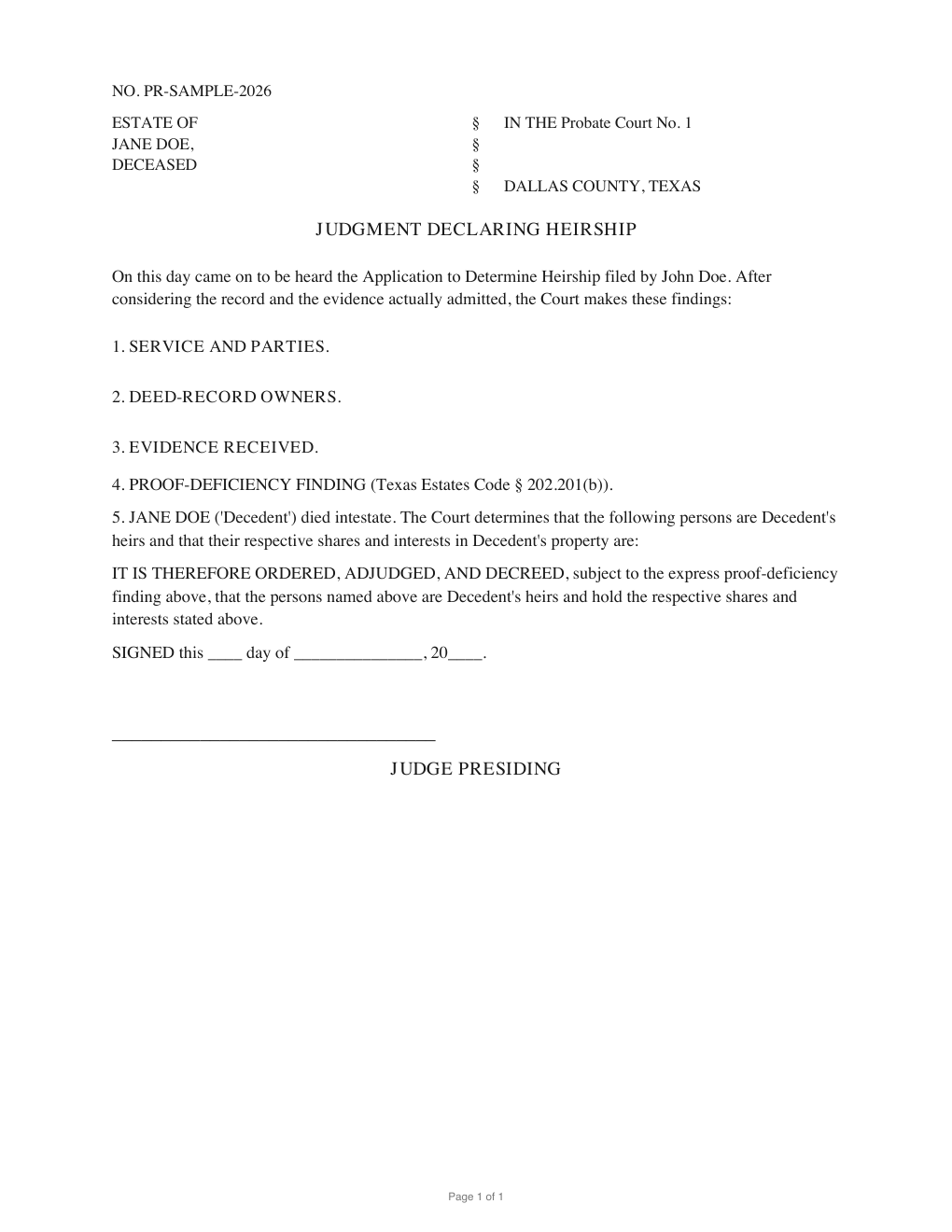
Where it goes
Filed with the probate court handling the estate, in person or through eFileTexas.gov.
Who signs
The judge signs the order after reviewing it. You prepare the proposed draft.
Oath or notarization
No notary is required.
You don't have to start with a blank form.
Legacywyse uses your estate details to prepare the documents specific to your probate path.
Build my free planTell us about the estate
Answer questions about the will, family, assets, and county. Your answers help identify the likely probate path.
Save your plan and open your workspace
Create your free account to keep your checklist and supported document drafts in one place.
Review the draft, then take the next step
Add the remaining details and review your document. Follow the instructions for signatures, notarization, or court review when required. You handle filing.
What to have on hand
Court details
The estate name, county, court, and case number, if one has been assigned.
Heirs and shares
The names of the heirs and the shares established in the court proceedings.
Hearing records
The application, testimony, and any findings or directions from the court.
Get the first three days checklist.
We'll email you a free 6-page guide to the first three days after a loss.
Filing fees by county
Fees to open the probate case. Confirm with the county clerk before filing.
| County | Filing fee |
|---|---|
| Dallas County | $388 |
| Tarrant County | $380 |
| Collin County | $385 |
| Denton County | $385 |
| Harris County | $432 |
| Travis County | $378 |
| Bexar County | $391 |
Let's take the next step together.
Answer a few questions about your situation, and we'll help you through what comes next.
Get started for free